


The September 11, 2001 attacks left everyone dazed and confused, trying to make sense of a multitude of things happening around them at once and news reporters had a very difficult time putting into words what they were seeing and what they were hearing, and if you are a hardened 9/11 conspiracy theorist, you’ll be well aware the TV coverage and witness testimonies are a rabbit hole all by itself.
Math Easy Solutions downloaded and combined all 500 PDFs of 9/11 firefighters, paramedics, and EMT witness testimony from the NY Times archive and combined them into a searchable 7,058 page PDF!
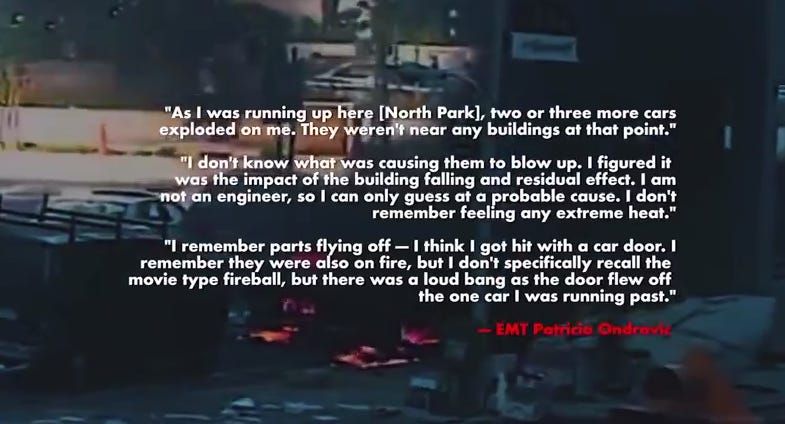
It reminded me of a conversation in March 2023, where I was in a conversation with a person on this group - with regards to explosions and the person did not want to give an opinion on what the source of the explosions were or what was exploding.
The discussion started with regards to explosions in the basement of the towers, before the buildings came down, with people being burnt and killed in the basements.
I asked what the person thinks could have exploded in the basements and I also referenced this video.
The person then referenced the “118 Witnesses: The Firefighters’ Testimony to Explosions in the Twin Towers” – see the PDF
Here is my reply – What do you think?
Ok, so I’ve read the 60 pages of testimony…
They all refer to explosions, great – So what caused the explosions? What was exploding?
There was a lot of chaos that day and everyone was trying to fit what was happening into a certain frame of mind of what they perceived explosions they were hearing to be.
Just because you hear something go boom, does that mean it’s a bomb?
I also found a few interesting statements as well.
George DeSimone, 9110129
South Tower:
The next thing I know, we heard a little bit of a rumbling, and then white powder came from the first collapsed building. I thought it was an explosion initially. We got hit with the powder. Wetried to run. [p. 6]
North Tower:
After that, I still thought it was an explosion. I thought it was some kind of thermal explosion where I'm either going to get burnt -- and I had kind of ideas that it was going to be something like Hiroshima where all this heat was coming at me and we were going to get burnt -- or if the heat didn't burn me, I thought that all the parts coming out of this building, the windows, metal, all the things like that, that I might be severed in half. [p. 7]
I don't think we understood the magnitude of what was going on. I was fearful that there were bombs in the building. That was my first thought, being the military kind of guy that I am. [p.10]
…
Brian Dixon, 9110166
South Tower:
I was watching the fire, watching the people jump and hearing a noise and looking up and seeing -- it actually looked -- the lowest floor of fire in the south tower actually looked like someone had planted explosives around it because the whole bottom I could see -- I could see two sides of it and the other side -- it just looked like that floor blew out.
I looked up and you could actually see everything blew out on the one floor. I thought, geez, this looks like an explosion up there, it blew out. Then I guess in some sense of time we looked at it and realized, no, actually it just collapsed. That's what blew out the windows, not that there was an explosion there but that windows blew out. [p. 15]
As I just got in under the entrance there, I got just a little way back and it was just like -- you hear the noise, a boom, and then a blast of air. [p. 16]
…
Kevin Duggan, 9110345
South Tower:
...we were standing there, and then we just heard this real loud roar. We looked up and we could see the south tower.
Looked like the middle of it was just exploding out, and at that point, one of the officers just
said, "Run"... [p. 7]
…
Jerry Gombo, 9110100
South Tower: collapse:
...it felt sort of like an earthquake. The sky darkened and you heard this thunderous roar. It was like a volcano, if you will, not that I ever experienced a volcano, but I guess that's the way I could describe it, and this cloud just coming down. The ground was shaking and this roar... [p.12]
North Tower:
No sooner did we get, I would say, several yards down Vesey Street heading east to west when the second tower came down, and once again this huge mushroom cloud... [pp. 18-19]
…
Timothy Julian, 9110386
South Tower:
...that’s when I heard the building collapse.
First I thought it was an explosion. I thought maybe there was bomb on the plane, but delayed type of thing, you know, secondary device.
Q. I was convinced for a week it was secondary devices.
A. You know, and I just heard like an explosion and a then a cracking type of noise, and then it sounded like a freight train, rumbling and picking up speed, and I remember I looked up, and I saw it coming... [p. 10]
…
David Loper, 9110349
South Tower:
Then all of a sudden there was like a loud -- almost like a rushing sound, a roar, and we looked up and we could see it looked like an implosion and the building kind of went in and out and kind of like shook...We were looking up and then this thing started coming down... [p. 10]
…
David Moriarty, 9110228
North Tower:
I looked up, and it appeared as if the north tower -- it almost appeared to be liquefied. The very top of it began to cascade out and down, almost in a rolling motion. [p. 7]
…
Keith Murphy, 9110323
South Tower: [As experienced from the ground floor of the NT.]
I had heard right before the lights went out, I had heard a distant boom boom boom, sounded like three explosions. I don’t know what it was. At the time, I would have said they sounded like bombs, but it was boom boom boom and then the lights all go out. I hear someone say oh, shit, that was just for the lights out. I would say about 3, 4 seconds, all of a sudden this tremendous roar. It sounded like being in a tunnel with the train coming at you. It sounded like nothing I had ever heard in my life, but it didn’t sound good. All of a sudden I could feel the floor started to shake and sway. We were being thrown like literally off our feet, side to side, getting banged around and then a tremendous wind started to happen. It probably lasted maybe 15 seconds, 10 to 15 seconds. It seemed like a hurricane force wind. It would blow you off your feet... [pp. 19-20]
…
Charles Wells, 9110163
South Tower:
We got to the point of being in between the Vista Hotel and the World Trade Center, at which point we heard a -- we felt a loud -- a very strong vibration, shaking, and a loud noise like a subway train coming through a station at speed, like a jet engine at full throttle. It was a roaring sound... [p. 6]
[After digging himself out of the collapse rubble.]
Everybody's heads were all popping up now. Everybody is digging out, so I ran into a couple of firefighters, and I said, "Well, you know, what the hell happened?" Some kind of an explosion, he goes, and that's what I thought it was... [p. 8]
…
Daniel Williams, 9110289
South Tower:
I turned my face back towards the buildings as -- looking up at the south tower. It seemed like the one floor exploded, but in retrospect I'm thinking that was the compressive force of the building coming down that blew it out. I remember yelling, "Run." [p. 4]
…
James Murphy, 9110323
South Tower: [This is the sound as heard from around the ground floor of the NT.]
I was looking down towards West Street, because that's where it seemed that it was coming from. You just heard -- I thought it was a third plane that hit, because when we were going in there was a couple of cops. When we made the right onto Liberty, they said, "Be careful, guys, there's a third plane heading in." So that's what I thought it was.
It just seemed like a long time that it was -- it didn't seem like an explosion. It was like boom, boom, and then just got louder and louder. It got louder and louder, and then all of a sudden I was looking out onto West Street and the whole area turned from gray to black in a hurry.
…
Glen Rohan, 9110404
North Tower:
We got approximately to Vesey, a little further past Vesey, I would say about 200 feet from the tower, when we heard a noise.
I wouldn't even call it an explosion, but it was enough to make you look up. When we looked up, you could see things coming off the sides of the building of what was then number One World Trade Center. We looked at it for probably about five seconds before I realized that this building is coming down.
So, again – All these testimonies are from people that witnessed and lived through MASSIVELY stressful events, and they try to make sense of what they experienced.
I do not want to take away from their experiences, but I ask the question again.
Does an explosion equal a bomb?
Question - Did you believe in Santa Claus and the Tooth Fairy?
Listen to this 5 minute discussion on Santa Claus, and the Tooth Fairy. Full interview
UPDATE TO ARTICLE
I have written additional articles building on this article;
Going in Search of Planes in NYC on 9/11 - Revisiting 1st Responders’ Accounts.
Was every BOOM on 9/11 a bomb? - Not everything that goes boom is a bomb.
The Forgotten Firefighters of Stairwell B of the North Tower - Firefighters Raul Angulo and Erik Lawyer explained the holes in the narrative on Redacted, yet they are withholding important evidence about their fellow firefighters.
The Forgotten 9/11 First Responder Testimonies - 499 Witness Testimonies from EMT’s, Paramedics and Firefighters paint a very different picture of what happened on September 11, 2001
Thank you for reading, thank you for watching, listening and still caring.
The long awaited “New Investigation”, read this very scary book by Dr Judy Wood.
For a 1h crash course into the destruction at the WTC watch the 9/11 Essential Guide.
For a crash course into all three sites on 9/11, watch 9/11 Alchemy: Facing Reality.
Free PDF book downloads by Andrew Johnson:
9/11 – Finding the Truth and also 9/11 – Holding the Truth
Also get your hands on: ChatGPT and 9/11 - Operation Headfake: A Thought Experiment with Artificial Intelligence, co-authored by Dr Morgan Reynolds, and John Herold, MA. Kindle edition & a link to standard colour printed edition.
If you like reading my articles and would like to buy me a coffee, please follow the link to my PayPal, as Substack does not allow for payments to my country, and the person who was helping me access funds paid to Substack, is holding my donations hostage.
If this is the first article of mine you’re reading, please rewind to my first article and work your way through all of them, as you’ve missed out on a lot of valuable 9/11 and “9/11 truther movement” information.
Come join the discussion on Telegram, find me on X and check out my Rumble channel.
Interesting conversation - I think ego has a lot to do with it - but there is also people who have bought in to an idea and their entire professional and social career is based on it. Vaccine science is an example two of the largest voices in the field (Hotez and Goff) have children with autism. How likely are they to admit that the vaccines they have spent their life developing and pushing may be linked to their own child's condition. Another one is Alison Singer who has a child with Autism and is the head of Autism Science Foundation - which supports research into Autism but states emphatically on their site that vaccinations do not cause autism. Then you have a heavily funded physician whose child died after c-19 vax and is denying any link but is rewarded with grants. I think in all those cases funding has been forthcoming from NIH and CDC at the price of silence. Money speaks to many. and others just sell their soul.
With 9/11 I think the biggest barrier to recognizing the truth is the implications. How many folks in congress do you think question the terrorist story. Hell they can't even mention 9/11 without terrorist - you have a whole industry built around wounded warriors and tunnel to tower and so many more - try telling them that what happened to them, their friends and relatives could only have been possible through a DEW or black budget operation which only their government had access to. You can go through history and find so many of these examples. Oil is called fossil fuel - but we have known since the end of WWII that it is abiotic - but with fossil fuel you can claim peak oil theory (which was developed by a Rockefeller/Shell Oil scientist) and scarcity and that is what drives prices up and can provide wealth. Even the oil embargo in the 70s was designed by Kissinger. Look at the attack on Israel - best defense in the world and they did not know - no wonder they are calling it their 9/11.
This discussion caught my attention because it touches something I learned from years of working in the field: what a person hears, sees, and believes during a critical event are not always the same thing.
The first report from the field is important, but it is only the beginning of the assessment. Under extreme stress, people describe events through what they understand at that moment. A loud boom may be called an explosion, a collapse may sound like a blast, and a sudden pressure wave may be understood as something else.
This does not mean that the testimony should be ignored. Quite the opposite. It should be preserved, compared, and studied carefully.
From a military field perspective, I would separate three things: what the person experienced, what the person believed happened, and what the available evidence can actually establish.
That distinction is very important when reviewing the 9/11 testimonies.
In my own field experience, I learned that a good assessment does not stop with the first report. We collect different observations, compare them, look for contradictions, and then reassess the situation as more information becomes available.
That is why I find this approach worth discussing. The real value of field testimony is not that it gives us an immediate answer. Its value is that it gives us another piece of the situation that must be tested against the wider evidence.
I would be very interested in continuing this kind of discussion from the perspective of field assessment, especially where first-hand observation, operational experience, and the later analysis of an event meet.
There is much more that field experience can contribute to this discussion.